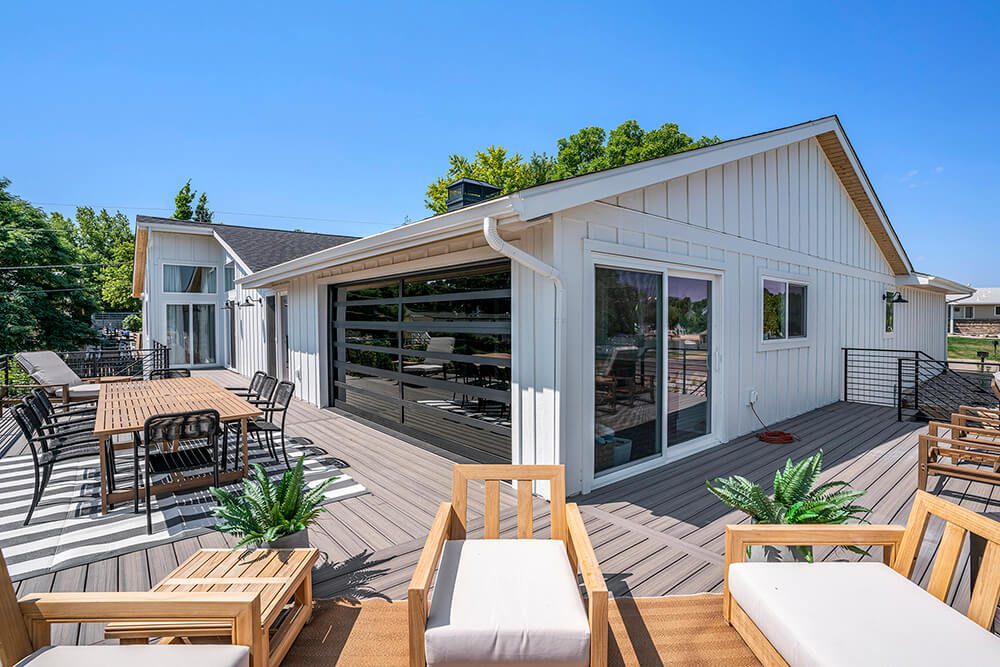
A backyard in Northern Colorado can be the best room in the house for half the year, or a patch of grass you mow and ignore. Whether a custom outdoor living space is worth the investment comes down to three things: what it returns at resale, how much you’ll actually use it, and whether it’s built for the weather it has to survive. If you’re weighing a patio, a deck, or a full build with our outdoor living and deck team, here’s how to judge the value before you spend a dollar.
Quick Answer: Is a Custom Outdoor Living Space Worth the Investment?
Often, yes, but not on resale alone. Standard outdoor projects hold their value well: the 2025 Cost vs Value report has a wood deck addition recouping 97.3% of its cost in the Mountain region, and NAR’s outdoor survey puts the same kind of deck at 89%, a paver patio at 95%, and an outdoor kitchen at 100%. Those figures are for standard-size projects, though. A custom build costs more, so expect a smaller share back at sale. The rest of the return comes from how often you’ll use the space and whether it’s built for Colorado sun, hail, and freeze-thaw.
What the Resale Numbers Actually Say
Resale data is the cleanest way to answer the money question, and outdoor projects hold their value well. Two surveys track this: the Journal of Light Construction’s Cost vs Value report, which breaks results out by region, and the National Association of Realtors’ Remodeling Impact Report on outdoor features, which is national. They use different methods, so the same project can score differently in each. Both price a defined, standard project, so treat the percentages as a floor for what a basic version returns, not a promise for a custom one.
Decks
The report doesn’t break out a Colorado city, so its Mountain region (markets like Salt Lake City, Boise, and Albuquerque) is the closest benchmark it offers. The 2025 figures:
- Wood deck addition: $18,253 average job cost, $17,753 resale value, 97.3% recouped
- Composite deck addition: $26,342 average job cost, $21,630 resale value, 82.1% recouped
Composite costs more up front and recoups a smaller share of it at sale. If you choose it, choose it for reasons other than resale.
Patios, Kitchens, and Fire Features
NAR’s most recent outdoor edition (2023) asked Realtors how much of each project’s cost a seller gets back:
- Paver patio (18 by 16 ft): $10,500 cost, 95% recovered
- Outdoor kitchen: $15,000 cost, 100% recovered
- Wood deck (14 by 18 ft): $16,900 cost, 89% recovered
- Gas fire feature: $9,000 cost, 56% recovered
A fire feature recovers the least on paper. It still earns its place when it turns a patio into somewhere you’ll sit in October.
Why a Custom Outdoor Living Space Pays Off Beyond Resale
Resale is only half the return. NAR found 68% of owners had a greater desire to be home after an outdoor project, and the typical “Joy Score” across projects was 9.7 out of 10. Outdoor kitchens scored highest on that front: 99% of owners said they wanted to be home more.
That’s the real case for building custom. A space designed around how you actually host, cook, and unwind gets used every week. A generic slab off the back door doesn’t.
Building for Fort Collins Weather
A space that looks great in a catalog can fall apart in a Front Range winter. Three conditions drive material choices here:
- Freeze-thaw. NOAA’s 1991-2020 normals for the Fort Collins station average 150 days a year with a low at or below freezing, but only about 15 days where the high stays at or below freezing. That’s a lot of nights that freeze and days that don’t, so hardscape takes a steady cycle of freezing and thawing. ASTM C1645 is the standard freeze-thaw test for concrete pavers, run in tap water or a saline solution depending on whether they’ll see de-icing salt, so ask whether a paver has passed it.
- Sun. Colorado State University’s Colorado Climate Center notes that high-elevation sunlight is intense enough to make sunburn a real problem. Shade structures and fade-resistant finishes aren’t extras here.
- Hail. The same source says severe hail is common across eastern Colorado, with some counties averaging 6 or more hail days a year. That figure isn’t specific to Fort Collins, so read it as a regional warning and choose covers and outdoor furniture with hail in mind.
Footings matter too. Fort Collins requires piers for attached decks to sit at least 30 inches below grade, the local frost depth.
What Most Guides Miss: Fort Collins Rules Shape the Design
National guides skip the local rules, and in Fort Collins a few of them change what you can build:
- Permanent wood-burning fire pits are out. They aren’t allowed inside city limits. Gas fire pits are allowed, but the gas piping and appliance need a permit, an inspection, and final approval, and the burner has to be listed to ANSI Z21.97. Without manufacturer clearances, the pit needs 10 feet from structures and combustibles, including a roof above. The gas work has to be done by the homeowner or a licensed plumber or HVAC contractor, so a landscaper without one on staff can’t install it.
- Many decks need a permit. Any deck attached to the house, more than 30 inches above grade, or over 200 square feet needs one.
- Pergolas have a size line. The City’s permit exemption for small detached structures names pergolas, and it only applies at 120 square feet or less, 8 feet tall or less, and at least 3 feet from any property line. A patio cover or pergola that bears on top of a deck needs engineered plans.
- Xeriscape incentives are closed for 2026. The City’s residential program isn’t taking applications this year, and the City says to check back in January 2027.
None of this is exotic, but it has to be settled before the design is final. Knowing it up front keeps a plan from getting redrawn after the permit review, and it keeps a fire feature you love from turning into one the City won’t approve.
How We Approach Outdoor Projects
Outdoor work is where Brad Loper started. He began in landscape construction, pursued landscape architecture before moving into hands-on building, and specialized in irrigation installation and repair. From there he became a master plumber, working on water systems and drainage. That combination matters on a gas fire feature, where the City wants a licensed plumber on the gas line. You can read more about Brad’s background in landscape construction on our About page.
Our outdoor work covers custom patios, outdoor kitchens, covered living spaces, fire features, dining and lounge areas, and custom hardscape. Every project runs through the same steps, and we lay out how our process works, from consultation through permitting to the final walkthrough.
Final Thoughts on Whether a Custom Outdoor Living Space Is Worth the Investment
The numbers say standard outdoor projects hold their value, and the owner surveys say people actually use them. What makes a custom outdoor living space worth the investment is building it for how you live and for the weather it has to survive. If you’d rather spread the cost out, you can look at Wisetack payment plans before you commit. When you’re ready, start a conversation with us and we’ll help figure out what your backyard should become.